

A 250-gram pouch of RYO tobacco lists at $105.00 AUD, while the current mandatory retail pouch quantity is 30 grams. That gap explains why pouch weight, rather than pack familiarity, is the figure an Australian adult buyer needs to check.
Pouch formats did not shrink in a straight line. Larger traditional weights such as 50g and 55g historically dominated Australian listings, and smaller formats only became more prominent later. An older product description can still name a familiar weight without showing that the format can be supplied lawfully today.
Weight is a measurable specification. It proves nothing about strength, safety or legal status, and an 8mg or 12mg label identifies a product variant rather than a comparable dose.
Table of Contents
- Tobacco Pouch Weights at a Glance
- Telling Tobacco Pouches Apart from Nicotine Pouches and Snus
- From 50 Gram Pouches to the 30 Gram Rule
- Reading Weight, Strength and Price per Gram
- Checking a Listing Before You Buy
- Confirm the Pouch Weight Before You Order
Tobacco Pouch Weights at a Glance
In Australia, a tobacco pouch usually means a retail pouch of roll-your-own, or RYO, loose tobacco. Use 30 grams as the dividing line between older pack descriptions and the current standard format, and use the Australian Government’s tobacco product changes page for current requirements and effective dates.
Older weights still matter when reading archived product descriptions, historical purchasing data and catalogue categories. Their appearance does not establish that the same format can currently be supplied lawfully.
Tobacco pouch weights by format and status
| Pouch weight | What the label can establish | Status in 2026 |
| 15 g | An older small-pack description | Historical context only |
| 20 g or less | An older small-pack category | Historical context only |
| 25 g and 27 g | Older sub-30 g formats | Historical context only |
| 30 g | Current reference quantity for RYO pouch format | Current standard reference |
| 40 g or more | An older larger-pack category | Historical context only |
| 50 g or 55 g | Familiar larger pouch descriptions | Verify against current requirements |
| 100 g | A by-weight or pouch-category listing; less than half the tobacco in a 250 g pack | Clarify package contents and legal status |
| 250 g | A genuine pouch contains 250 g of loose tobacco; a heading may still describe an order total | Clarify package contents and legal status |
| 1 kg | May describe total weight; often supplied as 10 x 100 g sealed packs | Clarify package contents and legal status |
The status column separates historical context, the current reference quantity, and by-weight listings requiring clarification. These are not interchangeable categories: evidence that a weight was once common is not permission to supply it now.
A bulk heading leaves one question unresolved. Does it describe the total order quantity, the contents of an individual retail package, or a grouped offer? A 1 kg entry, for example, can mean ten sealed 100 g packs rather than one loose retail pouch.
Practical rule: A catalogue label describes an offer. It does not, by itself, establish the offer’s regulatory status.
Read listings in this order: find the net weight, match it to the table, then calculate price per gram before comparing products. Variant labels such as 8 mg or 12 mg identify product lines; they are not measured dose per cigarette and should not be read as safety rankings.
This table covers weight only. It does not classify blend, cut, flavour, nicotine delivery or value, and none of those characteristics should be inferred from the quantity printed beside a product name. Tobacco products are for adults of the applicable legal age, for personal use only, and must be handled under Australian laws and regulations.
Telling Tobacco Pouches Apart from Nicotine Pouches and Snus
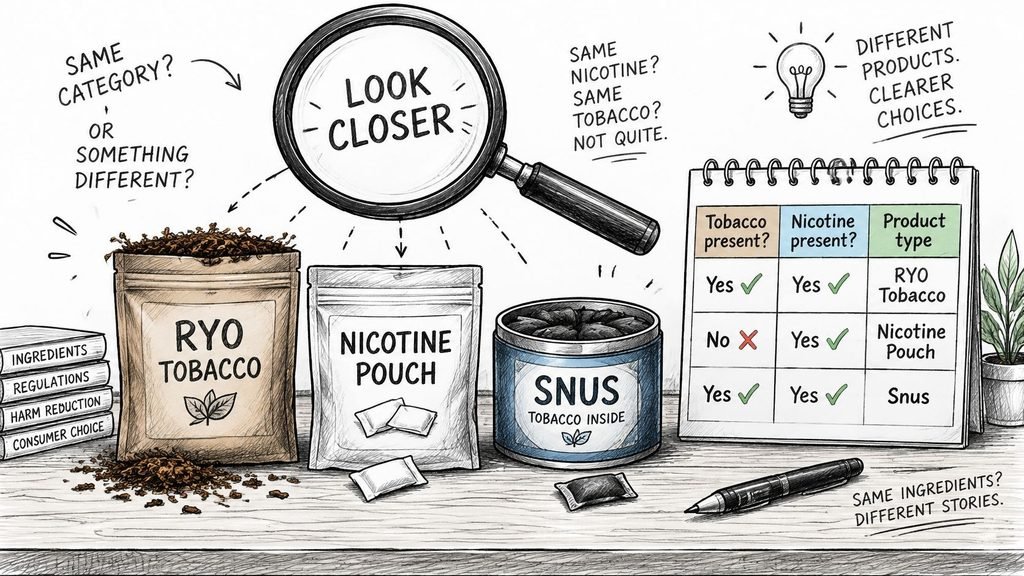
The word pouch can identify the packaging around loose tobacco or a small sachet containing nicotine. Treating those meanings as equivalent can lead a buyer to apply the wrong rules to the wrong product.
The Therapeutic Goods Administration describes nicotine pouches as tobacco-free sachets and states that they haven’t been evaluated for quality, safety or efficacy. Its Australian guidance on nicotine pouches also distinguishes them from snus, which has been prohibited from supply in Australia since 1991.
Tobacco pouch, nicotine pouch and snus compared
| Product | Contains tobacco | Australian status |
| RYO tobacco pouch | Yes | A tobacco product subject to applicable sale and packaging requirements; intended only for adults of legal age |
| Nicotine pouch | No; a tobacco-free sachet | An unapproved therapeutic product; not evaluated by the TGA for quality, safety or efficacy |
| Snus | Yes | Prohibited from supply in Australia under the rule described above |
Tobacco-free isn’t a safety finding. It describes the absence of tobacco, not an assessment of the finished product’s quality or suitability.
Questions that establish the product category
Is this RYO tobacco, a nicotine pouch or snus? Check the contents and the intended product format, not just the word pouch in the title. If the description doesn’t explain whether tobacco is present, the product category remains unresolved.
Can it legally be sold or imported? Verify the relevant Australian regulatory position before proceeding. A foreign label, an accessible checkout or a familiar brand name isn’t a substitute for that verification, and a product’s sale status shouldn’t be assumed to settle its import status.
Does tobacco-free mean risk-free? No. The TGA’s lack of evaluation gives no basis for treating these products as approved, safe or effective.
Enforcement reporting provides a separate reason to scrutinise availability claims. In 2024, Australian Border Force figures reported by the ABC recorded more than 1.3 million nicotine pouches seized since January, compared with 136,694 during the preceding two years, as detailed in the ABC’s report on nicotine-pouch seizures.
Those figures don’t identify the status of any particular listing. They do show why the existence of a supply channel shouldn’t be mistaken for regulatory approval.
For regional buyers evaluating unfamiliar products online, written clarification is more useful than assumptions based on appearance. Retain the product description and ask precisely what the item contains, which category applies and what supports its proposed Australian supply.
From 50 Gram Pouches to the 30 Gram Rule
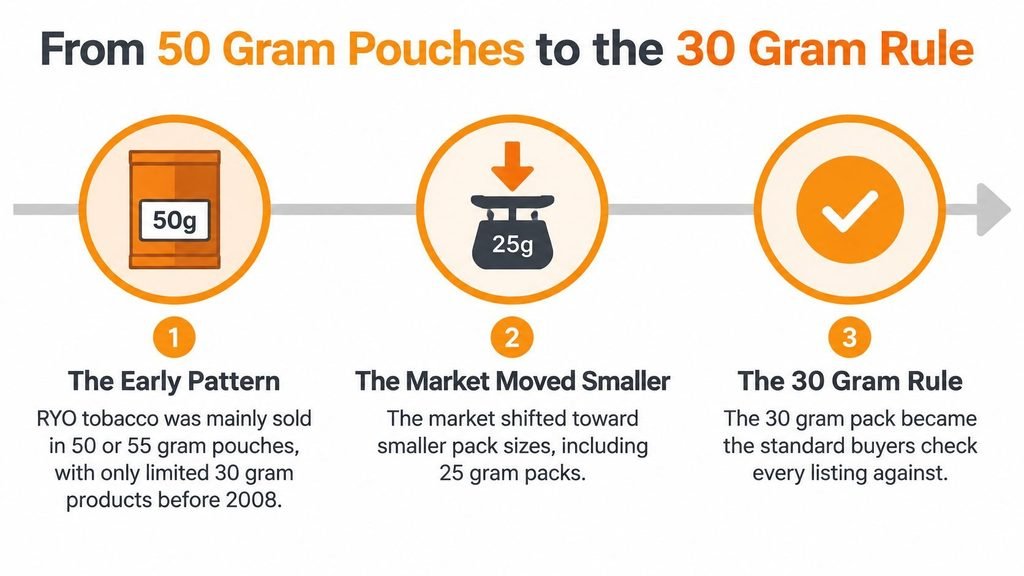
Australia’s pouch history has distinct stages: larger traditional formats, a broader range of smaller quantities, and mandatory standardisation. The historical evidence cited at the opening documents that progression, but the stages answer different questions.
The early formats explain why adult buyers may remember larger pouches as normal. The later expansion of smaller formats explains why an older product name or purchasing habit may refer to quite different quantities.
A changing quantity behind a familiar product name
Historically, manufacturers primarily supplied the larger traditional weights shown in the reference table. Smaller options subsequently became more prominent, including intermediate formats and very small pouches.
Student purchasing research also recorded a spread across small, intermediate and larger quantities. That evidence matters as a description of the former market, not as guidance for adult purchasing or a statement about current legal pack sizes.
The analytical distinction is between a product format that existed and a format that can now be supplied. Historical sales data answers the first question. Current packaging requirements answer the second.
Think of a supermarket shelf where cereal boxes repeatedly change size while retaining familiar product names. A buyer who compares only the price on the shelf can miss a change in quantity. Fixing a standard quantity removes that particular source of variation, but it doesn’t make different products identical.
Packaging reform changed more than quantity
Plain packaging became mandatory for tobacco products sold, offered for sale or supplied in Australia on 1 December 2012, alongside expanded health warnings. The government’s supplementary guide for non-cigarette tobacco products explains its application to products including RYO pouches.
Plain packaging doesn’t mean the complete absence of a brand name. It means promotional branding and presentation can’t be used as they would be on ordinary consumer packaging; permitted identifying information must follow the prescribed format.
The later quantity reform created a separate constraint. Buyers therefore need to distinguish how a package looks from how much tobacco it may contain. Satisfying one requirement doesn’t establish compliance with the other.
An older pouch weight can explain a listing’s history. It cannot establish the listing’s present legality.
An older-format product page, such as a 50g tobacco pouch listing, should therefore prompt a specific question about the actual retail units proposed for supply. The title alone doesn’t answer it.
What buyers should conclude about older stock
The cited materials don’t establish a general permission for older-format stock to remain on sale indefinitely. Nor should a buyer infer an exemption merely because a listing has remained accessible.
Where stock is described as transitional, ask what rule permits its present supply and how the supplied packaging meets that rule. If the explanation is unclear, postpone the order rather than treating an old catalogue entry as evidence of compliance.
Our tobacco products are intended only for adults of the applicable legal age and must be used and handled in accordance with Australian laws and regulations. Federal and state or territory requirements can affect sale, supply, packaging and delivery.
The government’s stated purpose is tobacco control, including reducing the capacity of packaging, presentation and pack size to influence purchasing. The buyer consequence is narrower but practical: establish the lawful sale unit first, then assess quantity and price on a consistent basis.
Reading Weight, Strength and Price per Gram
A 30 g pouch is the reference point for the arithmetic. Sizes above that line can still appear in product titles and older catalogue entries, so the first check is whether the stated weight describes one retail pouch, a multi-pack order, or a bulk quantity split into sealed units.
Gram weight states mass only. A 250 g pouch contains 250 grams of loose tobacco, while a 100 g pouch contains less than half that amount. Neither figure says how much nicotine a person will absorb, and an 8mg or 12mg label cannot be read as a dose comparison unless the seller states what is measured, the reference unit, and whether comparable products use the same basis.
Keep quantity and measurement claims separate
A listing may place weight, blend, cut and an apparent strength figure beside the same product name. Their proximity does not make them interchangeable specifications.
The useful distinction is:
- Net weight identifies the stated quantity of tobacco.
- Blend and cut are separate product characteristics and need their own descriptions.
- A milligram claim needs a measurement basis and a reference unit before it supports comparison.
- Price per gram expresses cost against quantity, not nicotine delivery or safety.
If the seller cannot explain a strength label, record that as missing information. Do not turn it into a dose estimate.
Worked price-per-gram example using listed RYO 12mg prices
These rows use listed store prices for RYO 12mg products and simple division. Prices can vary between products and can change over time, and the product, brand, pack specifications and applicable Australian tobacco regulations can affect the figure shown at purchase.
| Listed product | Stated quantity | Listed price | Implied price per gram |
| 100g Tobacco RYO 12mg | 100 g | $70.00 AUD | $0.70 per g |
| 250g Tobacco RYO 12mg | 250 g | $105.00 AUD | $0.42 per g |
| 1kg Tobacco RYO 12mg | 1,000 g, usually 10 x 100 g sealed packs | $320.00 AUD | $0.32 per g |
A lower per-gram result shows scale, not equivalence. The 1 kg arithmetic depends on recognising that the order is commonly supplied as ten sealed 100 g packs rather than one loose kilogram pouch. For larger advertised quantities, a guide to interpreting kilogram tobacco prices should be read with that same separation between total order weight and individual sale units.
Use the method in this order:
- Read the net weight. Establish whether it describes one package or the complete order.
- Read the total price. Confirm it applies to the same quantity.
- Divide price by grams. Keep currency and weight basis consistent.
- Compare like with like. A pouch, carton and cigarette packet answer different questions.
Comparison limit: Price per gram measures the cost of a stated quantity. It does not prove product equivalence, compliance or effect.
These products are intended only for adults of the applicable legal age, for personal use only, and must not be resold. Australian federal and state or territory laws can affect sale, supply, packaging and delivery.
Checking a Listing Before You Buy
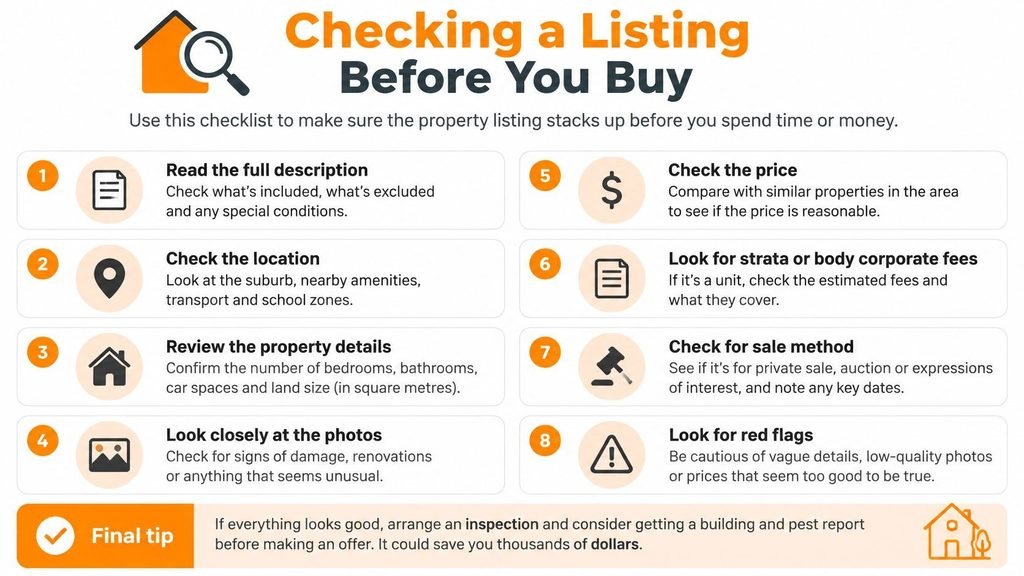
A serviceable listing lets an adult buyer identify the product, understand the supplied units and inspect the packaging. Missing information isn’t a harmless detail when it prevents any one of those checks.
A milligram figure illustrates why. An 8mg or 12mg label records a strength category printed on the pack. It doesn’t state a dose per cigarette or per gram, so two listings carrying different numbers can’t be ranked on that field alone. Each check below answers a different question, and no single field can stand in for the others.
Check the product and its retail package
- Net weight. Confirm the quantity stated for each retail unit, not just the total order. Match the supplied unit against the current 30-gram standard and flag any bulk description that leaves its packaging unexplained.
- Tobacco blend and cut. Read these independently of weight and any milligram label. If either characteristic matters to your comparison, an absent description leaves that comparison incomplete.
- Packaging format and dimensions. Loose processed tobacco must use a compliant primary package that is a pouch, small cylinder or large cylinder. For a pouch, the largest dimension must be at least 85 mm and the second-largest at least 55 mm, according to the government’s guide to tobacco packaging requirements.
- Plain packaging and warnings. Retail packaging must use Pantone 448C with a matt finish, without logos, promotional imagery or decorative colour treatments, and required health warnings must remain visible. Check identifying text and presentation against the Australian Government’s plain-packaging requirements rather than assuming a dark-coloured package is enough.
- Brand or manufacturer. Establish who is identified in the listing and whether the supplied product matches that description. An absent or unexplained identity is grounds to request further information, not proof of any particular offence.
- Product-specific information. Read the details attached to the exact item rather than relying on a collection heading. Cigarette papers and filters are separate products from loose tobacco, so don’t assume they’re included.
A collection heading such as 100g pouch tobacco states a weight category, not a guaranteed sale unit. Apply the checks to the item and its proposed retail packaging, and ask us to clarify an unclear sale unit before proceeding.
Treat unexplained fields as reasons to pause
The pouch dimensions serve a regulatory purpose: they create space for required warnings and product information. A photograph may not establish them, and a stated number doesn’t prove compliance on its own.
Each item below is a reason for further verification, not a substitute for a regulator’s assessment of a particular product. Pause when you encounter:
- No net weight, or no distinction between order weight and retail-unit weight.
- Decorated packaging, including promotional logos or imagery.
- Hidden or missing warnings in the proposed retail presentation.
- Unexplained nicotine claims without a measurement basis.
- Unclear manufacturer information that prevents product identification.
- An unverifiable pack format or an unsupported explanation of its status.
Confirm the Pouch Weight Before You Order
A verified listing answers three questions: what the pouch weighs, whether that format is lawful for retail supply, and who supplied it. An available payment option resolves none of these, and a familiar catalogue description does not remove the need to check the supplied package.
Apply these final checks before committing to a purchase:
- Match the stated weight to its status. Use the reference table to distinguish historical formats, the mandatory standard and bulk descriptions that need clarification. Resolve any difference between the advertised total and the individual retail units. A 1kg order described as 10 x 100g sealed packs states both the bulk total and the retail-unit weight; a bare “1kg” figure does not.
- Check the actual listing. Packaging, manufacturer identification and product-specific information matter at item level. If an image and the written description conflict, ask which one accurately represents what will be supplied.
- Confirm eligibility and permitted use. Purchases are restricted to adults aged 18 or over. All tobacco and smoking products are for personal use only and must not be resold.
The online ordering process involves selecting the product, completing age verification and paying by bank transfer. Each step presumes the listing was already clear. The checkout does not verify the product for you.
Resolve uncertainty before payment
If older stock, an unclear weight or a bulk description raises questions, contact the store through its website before ordering. Ask for confirmation of the net weight, the individual retail packaging and the basis for current supply.
A stated quantity is a compliance matter as well as a comparison detail. An unverified weight is a reason not to order.
Cigarette Store Australia offers cigarettes, rolling tobacco and related products through an age-verified online storefront. Review product details, and contact the store through its website before payment if a pouch weight, strength label or proposed retail format needs clarification.
Leave a Reply