

A legal 200-stick carton carries hundreds of dollars in excise before GST, wholesale costs, logistics, or retail margin are added. That’s the starting point for understanding Tobacco Prices Australia. The shelf price isn’t mainly a brand decision. It’s a tax calculation with a product attached.
That distinction matters because it gives you a test you can apply to any listing. Separate the tax stack from the product price. Work out the excise floor for the size you’re buying. Then ask whether the advertised price clears that floor. If it doesn’t, you haven’t found a bargain. You’ve found a question you need answered before you pay.
The figures that follow are benchmarks, not predicted shelf prices. They won’t tell you exactly what a retailer will charge. They will tell you what the government takes first, and that’s the number most price guides leave out.
Table of Contents
- What Tobacco Costs in Australia in 2026
- Why Excise Makes Up Most of the Price
- Calculate the Real Cost Before You Buy
- Rolling Tobacco Versus Factory-Made Cigarettes
- Why Very Cheap Tobacco Is a Warning Sign
What Tobacco Costs in Australia in 2026
The table below shows the excise component alone for common purchase sizes, using the rates in force from 3 March to 31 August 2026. Those rates are AUD 1.52829 per stick for cigarettes containing no more than 0.8 g of tobacco per stick, and AUD 2,445.26 per kilogram for loose tobacco, as set out in the ATO excise duty rates for tobacco.
Excise Component by Purchase Size March to August 2026
| Product | Quantity | Excise component | Notes |
|---|---|---|---|
| 20-stick pack (cigarettes) | 20 sticks | $30.57 | Tax only, before GST and margins |
| 200-stick carton (cigarettes) | 200 sticks | $305.66 | Same per-stick rate, ten packs |
| Loose tobacco pouch | 50 g | $122.26 | Per-kilogram rate, not per-stick |
| Loose tobacco pouch | 100 g | $244.53 | Per-kilogram rate, not per-stick |
| Loose tobacco pouch | 250 g | $611.32 | Per-kilogram rate, not per-stick |
| Loose tobacco pack | 1 kg | $2,445.26 | Rate changes in September indexation |
How to Read Each Row
Start with the pack. Twenty sticks multiplied by the per-stick rate gives you roughly $30.57 in excise. Nothing else is in that number. There’s no tobacco leaf cost, no manufacturing, no packaging, no freight, no shop rent. It is tax, and only tax.
The carton works the same way, just scaled up. Ten packs don’t attract a bulk discount on excise. The rate is per stick, so 200 sticks produce ten times the tax of 20 sticks. If a carton looks dramatically cheaper per pack than a single pack from the same legal channel, the difference has to come from margin or wholesale pricing, because the excise per stick doesn’t move.
Loose tobacco is where readers most often misread the numbers. It isn’t taxed per cigarette you eventually roll. It’s taxed per kilogram of tobacco content, so the excise rises in direct proportion to weight. A 50 g pouch carries about $122.26 and a 100 g pouch carries about $244.53, using the same per-kilogram rate cited above. The 250 g figure of $611.32 is just one quarter of the kilogram rate.
Practical rule: Treat every figure in this table as a floor. A legal shelf price sits above it, never below it.
What the Floor Excludes
Each figure excludes GST at 10%, which applies on top, and it excludes wholesale, logistics, and retail margin components. So the gap between the table and a real shelf price isn’t evidence of overcharging on its own. That gap is where every commercial cost lives. What the table does show is how little room there is for a legal seller to discount. If most of the price is already committed to excise, a large price cut has to come from somewhere, and it can’t come from the tax.
The table is also dated. Rates reset each March and September, so a price you checked in February uses a different rate from one you check in April. Don’t carry an old floor forward and treat it as current.
Here’s the action. Find the size you buy. Note the floor in that row. Then check the shelf price against that floor before you compare brands, blends, or packaging. Brand comparison only becomes meaningful once both prices clear the same tax floor.
Why Excise Makes Up Most of the Price
The current floor didn’t arrive in one step. It was built through a series of dated tax decisions, and those decisions explain why tobacco prices in Australia move even when nothing about the product changes.
On 30 April 2010, the Australian Government raised tobacco excise and equivalent customs duty by 25%, taking the per-stick rate from $0.26220 to $0.32775 and loose tobacco from $327.77 to $409.71 per kilogram, according to the ATO explanatory material on the 2010 excise increase. A single decision shifted the tax floor across packets, cartons, and loose tobacco at once.
Staged increases followed through the middle of the decade. The pattern matters more than any single step. Repeated increases compound, so each rise applies to a base that already includes the previous rises. A given percentage on a taxed-up base adds more dollars than the same percentage on the original rate.
The Indexation Switch
The indexation mechanism itself then changed. Rather than tracking consumer prices, the excise became tied to wage growth, applied at the twice-yearly reset points covered above. That detail is easy to overlook, and it is the most important one for a buyer: the tax was designed to rise with wages, so tobacco wouldn’t become relatively more affordable just because incomes grew.
The illustration below shows the cumulative direction of those changes.
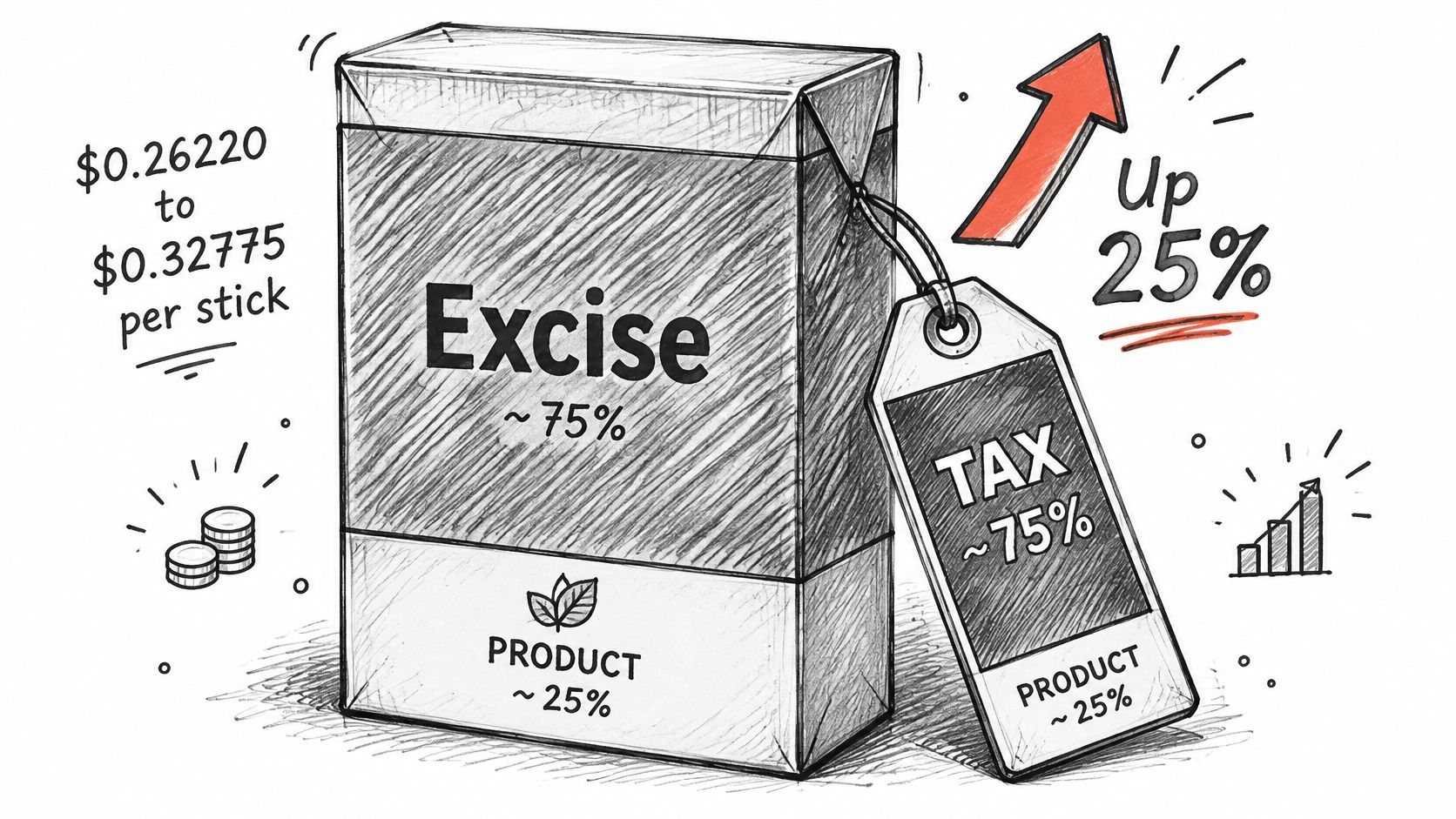
By the time those increases had run their course, tax accounted for the majority of the recommended retail price among leading cigarette brands, once GST was stacked on top of excise. For those brands, the tax stack was larger than everything else in the price combined. Leaf, manufacture, freight, wholesale, and margin together occupied the minority share.
Scale of Duty Collected
The ATO reported tobacco duty paid of $12.7 billion in 2022-23, up from $10.612 billion in 2016-17, in its tobacco duty paid data. Those figures measure duty collected nationally, not the price of an individual pack, so they won’t tell you what a carton should cost. They do show scale. Excise isn’t a minor line item in this market. It is the dominant economic force in it.
That has a direct implication for anything priced unusually low. The excise component of a legal price is set by statute and resets on schedule, so a retailer can’t discount it away. When a shelf price moves, check the calendar first: a change near a reset date points to the tax, and only after that is ruled out does a pricing decision become the likely explanation.
Calculate the Real Cost Before You Buy
You don’t need special software to test a listing. You need the product’s classification, its quantity, and the rate in force on the day you’re checking.
The five steps below follow the sequence in the infographic.
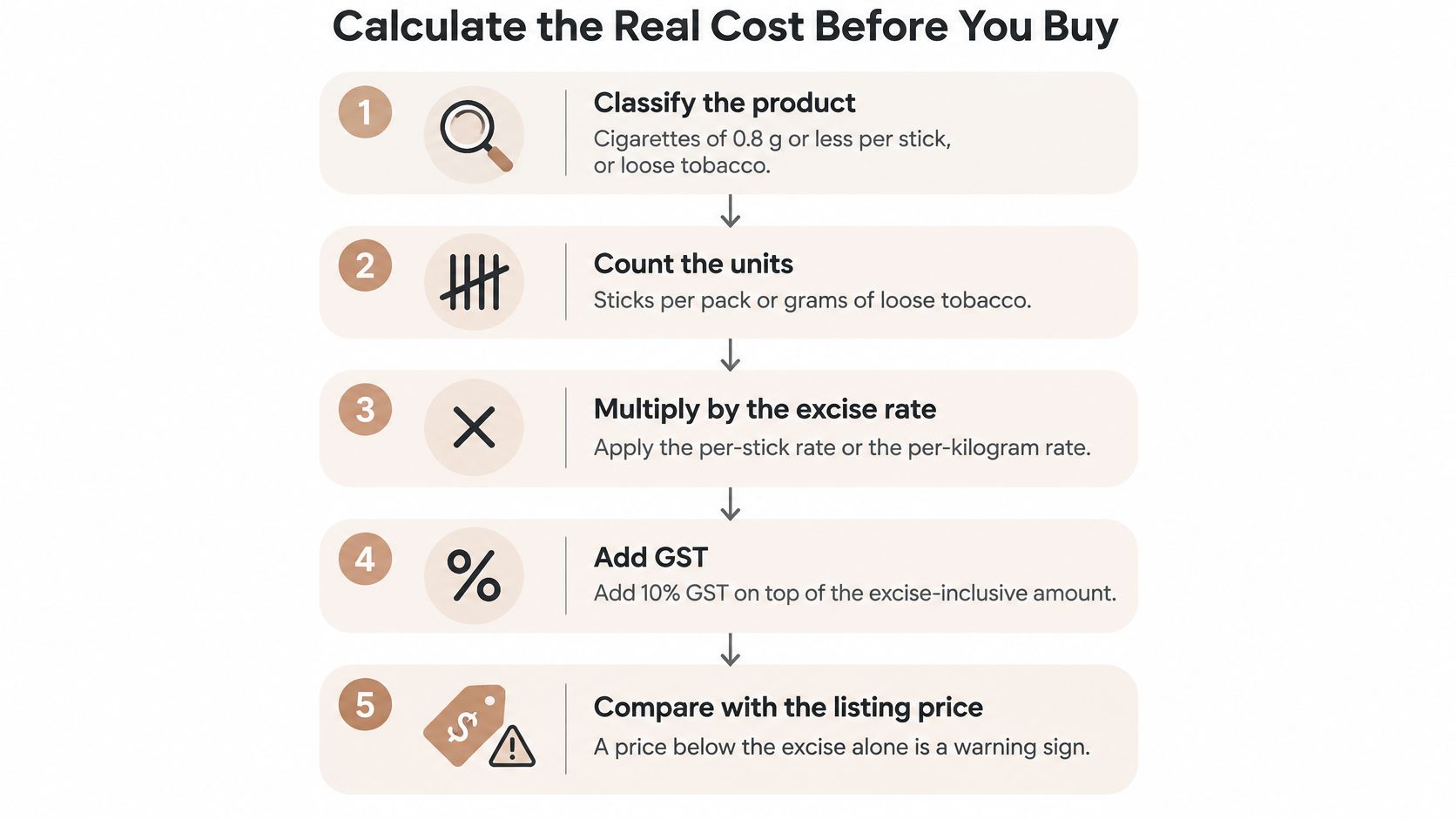
The Five Steps
- Classify the product by excise tariff. Is it a cigarette of 0.8 g or less of tobacco per stick, or is it loose tobacco taxed by weight? This decides which rate you use, and getting it wrong invalidates everything after it.
- Convert the pack into taxable units. Count sticks for cigarettes. Convert grams to kilograms for loose tobacco, so 250 g becomes 0.25 kg.
- Multiply by the rate in force. Use $1.52829 per stick or $2,445.26 per kilogram for the March to August 2026 period covered in the first table.
- Add GST and commercial costs. Apply GST at 10%, then allow for wholesale, logistics, and margin components to move from a tax floor toward a shelf price.
- Re-run the calculation for September. Rates are indexed twice yearly, so a calculation that’s correct in August can be out of date weeks later.
For larger loose tobacco quantities, our guide to the 1kg tobacco price in Australia and cost per gram sets out the same per-kilogram method applied to a full kilogram.
Worked Example
Take a 200-stick carton where every stick falls within the 0.8 g category. Multiply 200 by the per-stick rate and you get approximately $305.66 of excise, or about $1.53 per stick, using the March to August 2026 rate in the first section. That’s before GST and before any commercial cost.
Now take a 250 g pouch of loose tobacco. One quarter of the per-kilogram rate gives approximately $611.32 of excise, or about $2.45 per gram, using that same rate period. Notice the two examples aren’t comparable as sticker prices. One is priced per stick and the other per gram, and you can’t judge which is cheaper until you convert both to the same unit.
Two Pitfalls That Distort Comparisons
- Comparing sticker prices without normalising size: A lower per-pack price can still mean a higher effective cost per cigarette or per gram once you divide by the actual quantity.
- Applying the cigarette rate to loose tobacco: Australia uses a separate per-kilogram rate for loose tobacco, and its tax treatment is subject to staged equivalisation changes, so the per-stick rate must never be used as a shortcut.
We sell both Australian and overseas tobacco brands, and tobacco can be bought online and picked up the same day or in a store. Whichever channel you use, the classification step comes first, because a carton of sticks and a pouch of loose tobacco never share a rate.
The Buying Check
Run these checks in order before you pay.
- Find your size in the first table: Note the excise floor for that exact quantity.
- Confirm the rate by date: Make sure you’re using the rate in force now, not the previous period.
- Convert the shelf price to a unit cost: Divide by sticks or by grams so you’re comparing like with like.
- Compare only equivalent products: Same class, same unit basis, same rate period.
- Pause on any price below the floor: A price under the excise alone can’t include the tax it’s legally required to carry.
Buy only at a price that clears the floor, from a seller who checks your age at checkout, and let the table settle any doubt.
That last point isn’t decoration. Customers must have their age checked before making a tobacco purchase, and a seller who skips that step is telling you something about how they handle the rest of their obligations.
Rolling Tobacco Versus Factory-Made Cigarettes
Many buyers assume loose tobacco is automatically far cheaper than factory-made cigarettes. On a legal, tax-paid basis, that assumption doesn’t hold up well.
The comparison below uses the Parliamentary Budget Office 2026-27 assumptions, which put the legal tax component at $1.76 per cigarette and $2.90 per gram of loose-leaf tobacco, against base product prices of $0.53 per cigarette and $0.68 per gram, as reported in the Parliamentary Library policy brief on combating illicit tobacco.
Factory-Made Cigarettes Versus Legal Loose Tobacco PBO 2026-27 Assumptions
| Product | Base price | Tax | Total per unit | Annual cost |
|---|---|---|---|---|
| Factory-made cigarettes | $0.53 per cigarette | $1.76 per cigarette | $2.29 per cigarette | $10,892 per year |
| Legal loose tobacco | $0.68 per gram | $2.90 per gram | $3.58 per gram | $10,181 per year |
These PBO figures differ from the ATO excise rate used in the first section, so treat this table as a model comparison, not a shelf price. Its value is that it puts both products on a declared unit basis. The annual figures in the table come from the same Parliamentary Library brief and reflect a representative consumption level under those assumptions.
For the factory-made side in more detail, see our breakdown of how much cigarettes cost in Australia in 2026.
The Break-Even Point
Here’s the result most buyers miss. Divide the factory-made total of $2.29 by the loose tobacco total of $3.58 per gram and you get about 0.64 g. That’s the break-even. At these assumptions, a roll costs more than a factory cigarette once it uses more than roughly 0.64 g of tobacco.
Run an illustrative case. A 0.7 g roll at $3.58 per gram costs about $2.51 in product and tax, which is more than the $2.29 factory-made unit in the same model. Roll thinner and the loose option wins. Roll thicker and it loses. The saving lives in your rolling habits, not in the pouch.
What Moves the Result
- Grams per cigarette: This is the single biggest variable, and it’s the one buyers rarely measure.
- Wastage: Tobacco lost to tearing, spillage, or relighting is taxed product you paid for and didn’t smoke.
- Papers and filters: These sit outside the per-gram figure and add to every roll.
- Consumption change: If rolling leads you to smoke fewer cigarettes, the annual cost falls for a reason that has nothing to do with price per gram.
The saving from loose tobacco is conditional, not automatic.
Test the Model Against Your Own Use
Multiply your grams per cigarette by cigarettes per day, then by 7 for a week and 365 for a year. Multiply the resulting grams by $3.58 per gram for loose tobacco, or multiply your cigarette count by $2.29 per cigarette for factory-made, using the PBO assumptions in the table above. Weigh a few of your own rolls if you can. One honest measurement tells you more than any pouch price.
Why Very Cheap Tobacco Is a Warning Sign
A pack priced below the tax it must contain fails basic arithmetic. Whatever the listing claims about bulk supply, imported stock, or a clearance deal, a legal price cannot sit under the excise floor. That floor turns a vague suspicion into a number you can check in under a minute.
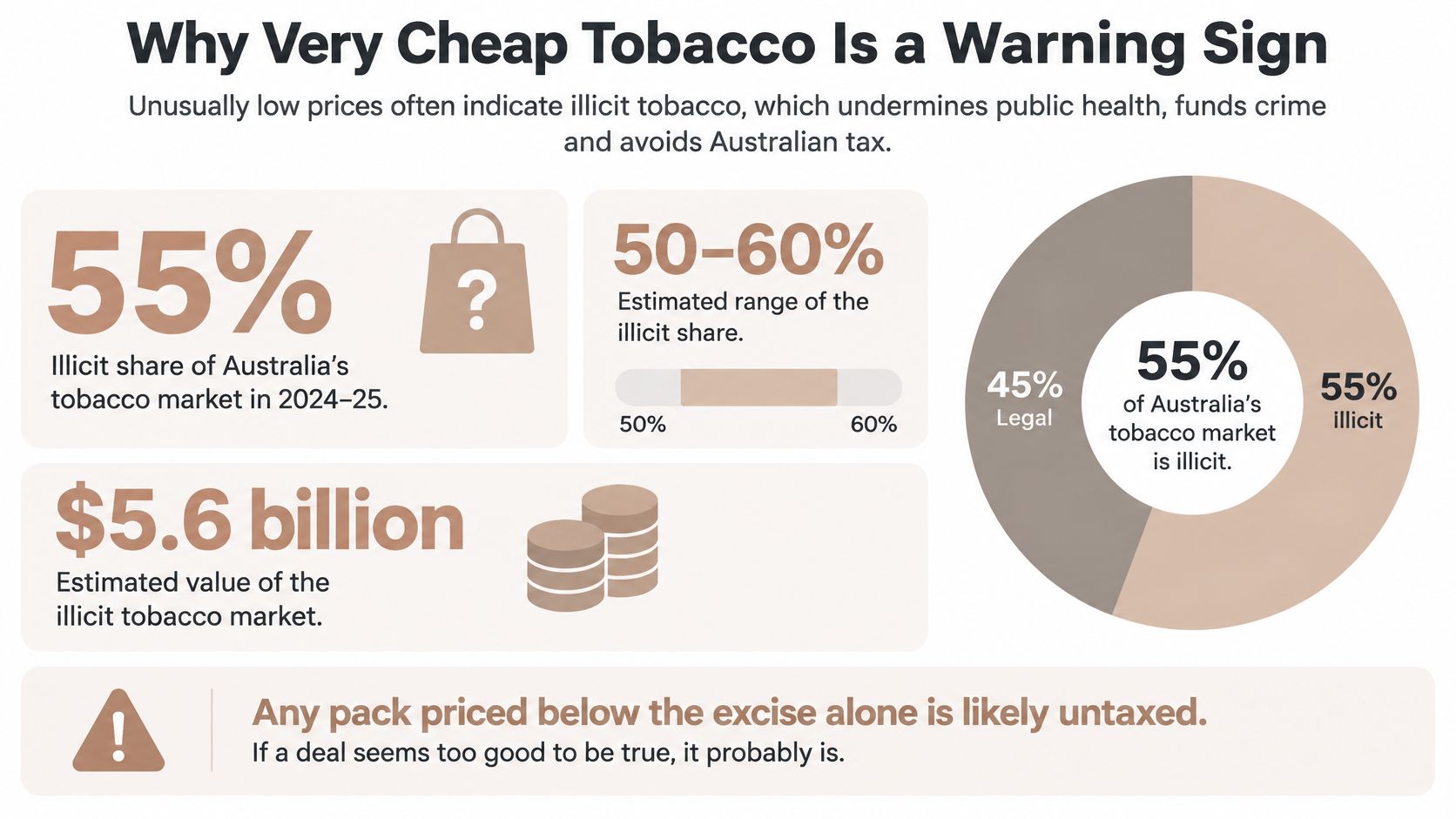
The 2024-25 estimate cited by Tobacco in Australia puts illicit tobacco at approximately 55% of Australia’s total tobacco market, with an estimated value of $5.6 billion and a possible range of 50% to 60%, according to Tobacco in Australia estimates of the illicit cigarette trade. On those figures, the untaxed market is roughly half of all tobacco sold. A buyer who only compares sticker prices is comparing one taxed shelf against a market where a large share of sellers never paid the tax at all.
The infographic below summarises that scale.
The Enforcement Picture
The ATO reported 177 illicit tobacco seizures between 1 July 2018 and 31 January 2025, totalling 479,781 kilograms and approximately $740 million in estimated evaded excise, as cited in the Tobacco in Australia chapter linked above. Seizures only capture what was found, so they understate the true volume, but they confirm how much product moves outside the tax system.
Set that against the legal position. A legal pack of 20 carried about $29.97 in tobacco tax in 2025, per the analysis cited in that same chapter. Offered a pack well below that figure, the arithmetic fails before you examine anything else. The price cannot contain the tax.
The video below walks through the difference between a taxed product and an untaxed one. https://www.youtube.com/embed/-uQLvakPXOA
The Tension in the Policy
The policy debate runs in two directions at once. High legal prices may cut legal consumption while pushing demand toward untaxed alternatives. Cutting excise could narrow that gap, and the argument against a cut is that cheaper legal product lowers the price of all tobacco and weakens the incentive to quit. Both effects can hold simultaneously. That is why the argument never settles, and why buyers should treat the excise floor as the operative test regardless of where tax policy lands.
For background on one of the product names buyers ask about most, our guide on where to buy chop chop tobacco in Australia explains what the term refers to and why it raises compliance questions.
Checklist for a Price That Looks Too Good
- Packaging and health warnings present: Look for compliant packaging rather than plain or unmarked product.
- Verifiable business name and address: A seller you cannot identify is a seller you cannot hold to account.
- Evidence of legal supply: Ask how the product was supplied and whether tax has been paid.
- Age check at checkout: A missing age check is a visible sign that other requirements may also be skipped.
If the price is below the excise alone, stop. The tax has not been paid, whatever the listing claims.
Illicit product gives you no reliable information about contents, origin, or handling. The excise floor test takes under a minute, and it is the strongest single check you have when a price for Tobacco Prices Australia looks unusually low.
Use the excise floor tables above before your next purchase, then compare our cigarette cartons and rolling tobacco in 50 g, 100 g, 250 g, and 1000 g sizes on a per-stick or per-gram basis. Age is checked before purchase, and you can order online with same day pickup or buy in store, so you can choose the channel that suits you. Start your comparison at Cigarette Store Australia and pay only when the price clears the floor for the size you are buying.
Leave a Reply